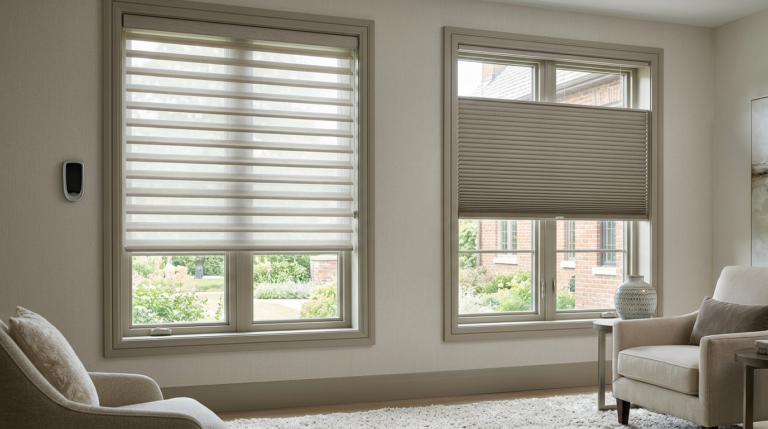
Navigating a guide to child safe features for window coverings ensures your home meets strict Canadian safety standards by eliminating hazardous dangling cords that pose entanglement risks. Custom Shades of London offers specialized shades for a secure nursery kids room, incorporating cordless spring rollers, wand controls, and automated shades. Choosing these inherently cordless designs and modern operating systems provides total peace of mind without sacrificing light control or daily convenience.
Overview
Modern residential design prioritizes eliminating strangulation risks by removing accessible operating cords from living spaces. Homeowners assessing child safe features for window coverings can review mechanical standards, manual spring rollers, motorized lifts, and rigid plantation shutters to protect younger family members.
The following sections outline Canadian safety standards, operational hardware comparisons, and specific room applications across family residences. A labeled real-world hypothetical examines specific mounting depth and hardware considerations for an older family home before concluding with practical replacement steps.
- Federal Regulations: Review current Canadian compliance requirements established under SOR/2019-97 standards.
- Spring Rollers: Examine spring-tensioned and push-button mechanisms designed for daily nursery protection.
- Automated Controls: Compare motorized remote systems and rigid wands that ensure cordless shade operation.
- Real-World Example: A labeled scenario outlines specific updates for older residential windows.
- Interior Shutters: Evaluate solid tilt-bar designs and cordless plantation shutters suited for active play areas.
- Replacement Steps: Follow actionable guidance on how to identify and remove hazardous household blinds.
Canada updated its Corded Window Coverings Regulations under the Canada Consumer Product Safety Act to restrict loose loops and limit accessible cords to a maximum length of 22 cm. Traditional corded blinds present strangulation risks for infants and toddlers, leading modern households to replace free-hanging pull cords with secure, physical barriers and tensioned hardware. A guide to child safe features for window coverings helps homeowners identify these safety hazards across bedrooms, playrooms, and living spaces.
Custom Shades of London supplies cordless lift systems, automated roller shades, and interior shutters engineered to meet these federal safety standards. Modern options such as Hunter Douglas LiteRise® spring-assisted rails, SoftTouch® wand controls, PowerView® smart automation, and inherently cordless Palm Beach™ Polysatin™ shutters remove dangerous strings while maintaining reliable light control and privacy throughout the home.
Corded Window Coverings Regulations and Canadian Safety Standards
Health Canada classifies corded window treatments as a severe strangulation risk for toddlers and young children, regulating these products strictly under the Canada Consumer Product Safety Act. Dangling operating strings and continuous loops remain among the top residential hazards identified by safety authorities. Federal standards establish explicit physical measurements rather than general childproofing suggestions:
- Non-loop cords: Any pull cord that hangs straight down without joining into a circle must not exceed 22 cm in length when pulled to its full extension from the headrail.
- Looped cords: Any cord configured as a closed loop must maintain a total perimeter no larger than 44 cm.
These precise numeric thresholds form the backbone of the federal Corded Window Coverings Regulations (SOR/2019-97). Rather than relying on aftermarket cleat brackets or temporary cord-shortening clips that fail to address the core entrapment hazard, modern nursery and kids room window coverings solve the problem at the manufacturing level by removing manual pull cords entirely.
When planning updates across London homes, our specialists measure each room to replace hazardous legacy blinds with spring-tensioned cordless lift profiles or motorized roller systems. You can schedule a free consultation to inspect existing window treatments and compare Canadian-compliant configurations for your family.
Cordless Window Coverings for Safe Nurseries and Playrooms
Childproofing an entire home requires addressing multiple hidden risks, yet window blinds frequently escape scrutiny until toddlers start exploring. Health Canada identifies cords as one of the primary safety risks for blinds and shades, citing strangulation as a severe hazard under the Canada Consumer Product Safety Act. Families preparing a secure nursery kids room can remove this hazard entirely by swapping traditional pull strings for completely cordless assemblies.
Canadian standards address this danger directly through national legislation. The Corded Window Coverings Regulations (SOR/2019-97) dictate strict physical limits on any exposed pull mechanisms:
- Non-loop cords: Must measure no longer than 22 cm from the exit point on the headrail to the end when fully extended.
- Loop cords: Must not exceed a continuous perimeter of 44 cm.
- Dangling hazards: Reachable operational strings that exceed these measurements are restricted on modern retail coverings.
Our specialists at Custom Shades of London help homeowners transition away from legacy strings by fitting modern operating systems that rely on smooth spring rollers, hidden gearboxes, or push-button bottom rails. In active play areas and bedrooms across London, Ontario, these cordless systems allow parents to lift or lower shades with a gentle tap, keeping the entire window frame free of reachable loops. Homeowners planning a nursery update can arrange a FREE consultation with our specialists to review certified cordless shade styles and precise interior mounts.
Federal Cord Limits and Safer Wand Control Alternatives
Health Canada identifies cords as one of the primary safety risks on blinds and shades because they present a severe strangulation hazard to young children. Under the Canada Consumer Product Safety Act, the federal Corded Window Coverings Regulations (SOR/2019-97) set strict physical thresholds for retail and custom products. These standards specify that any cord that does not form a loop cannot extend beyond 22 cm when measured from its exit point to the end while fully pulled out. For cord structures that form a closed loop, the total perimeter cannot exceed 44 cm.
Homeowners planning updates to a nursery or child’s room often discover that older window installations carry continuous dangling strings that breach these safety parameters. At Custom Shades of London, we recommend eliminating pull cords entirely rather than attempting temporary cord-cleat wraps that leave accessible loops exposed. Integrating rigid controls or automated lifts removes the mechanical hazard while keeping daily operation simple across wide or tall openings.
Upgrading to Free Powerwand motorization on Alta Window Fashions systems provides a dependable push-button mechanism directly attached to a smooth wand, avoiding hanging cords altogether. For homes with multi-level layouts or rooms requiring seasonal thermal management against Southwestern Ontario winters, these systems maintain neat sightlines without free-hanging controls. Scheduling a free consultation with our specialists allows parents to test tension-free manual wands and motorized lifters in person, confirming that every installed shade meets federal requirements from day one.
Health Canada Cord Safety Limits and Home Retrofit Strategies
Health Canada classifies corded window treatments as a severe strangulation hazard for young children under the Canada Consumer Product Safety Act. To address this risk across London households, the federal Corded Window Coverings Regulations (SOR/2019-97) set strict physical dimensions for operating mechanisms: any accessible pull cord that does not form a loop must not extend beyond 22 cm, while any cord forming a closed loop must maintain a perimeter of 44 cm or less. Traditional blinds manufactured prior to these benchmarks frequently leave long strings dangling near floor trim, beds, and toy bins.
Property owners updating family spaces can schedule a FREE consultation to review compliant upgrades that permanently remove strangulation risks. When managing older properties in historic London areas such as Old South and Wortley Village, deep timber window casings and plaster moldings often hold legacy horizontal mini-blinds with long lift cords. While hardware accessories like wall cleats or cord-shortening clips are marketed as quick fixes, they require constant manual winding and do not meet the inherent safety profile of modern cordless assemblies.
We install certified cordless systems that completely eliminate free-hanging pull loops from daily living spaces. Homeowners choosing treatments for a Nursery Kids Room often select cordless cellular shades, which use tensioned internal springs within the bottom rail to raise and lower the fabric smoothly. In addition to meeting modern safety regulations, the honeycomb cell structure delivers thermal insulation against cold London winters, keeping children comfortable and safe throughout the year.
Health Canada Cord Safety Rules and Regulations
Health Canada classifies corded window treatments as a primary strangulation risk for infants and toddlers under the Canada Consumer Product Safety Act. To safeguard households, federal rules enforce precise dimensional limits on every manufactured product. Before selecting new coverings, book a FREE consultation with our specialists to review compliant operating mechanisms directly in your space.
Specific Cord Length and Loop Limits
Under the official Corded Window Coverings Regulations (SOR/2019-97), Canadian standards divide pull systems into two separate structural categories rather than applying a single universal length rule:
- Unlooped pull cords: Any single cord that does not create a closed loop cannot exceed 22 cm in length when fully extended from its exit point on the headrail.
- Looped cords: Continuous operating cords or joined strands must maintain a total perimeter no greater than 44 cm.
Health Canada advises property owners to swap out treatments with long accessible cords in favor of certified cordless mechanisms. Exploring compliant Window Coverings allows London homeowners to remove dangling hazards completely. Our installers fit spring-assist rollers and tensioned cellular shades that keep play areas secure while maintaining steady thermal protection through Southwestern Ontario winters.
Health Canada Cord Standards and Practical Replacement Steps
Health Canada treats corded shades as a primary strangulation risk for young children under the Canada Consumer Product Safety Act. To address this household danger, federal mandates set clear physical boundaries for operational strings under the Corded Window Coverings Regulations (SOR/2019-97). Rather than relying on temporary tie-downs or cleats, modern safety practices require eliminating accessible strangulation loops completely.
Canadian standards distinguish between pull strings and continuous loops with strict mechanical thresholds:
- Unlooped cords: An operating string that does not form a loop cannot extend past 22 cm, measured from the exit point on the headrail down to the tip when pulled to its lowest drop.
- Looped cords: Any operational loop must maintain a total perimeter of no more than 44 cm to prevent a child’s head from becoming entangled.
Our installers at Custom Shades of London inspect older homes throughout the area, where vintage treatments frequently exceed these dimensions. While property owners often look for cord-shortening kits or tensioners, field experience proves that manual retrofits rarely match the protection of factory-built cordless systems. Selecting certified window coverings manufactured without dangling strings guarantees compliance with federal rules while removing child hazards from play areas.
Property owners planning nursery updates or broader renovations can schedule a FREE consultation to review manual lift-and-lock bases, wand mechanisms, and automated roller shades built specifically for child-safe households.
FAQ
To help you navigate safety regulations and modern cordless options, we have compiled a guide to child safe features for window coverings addressing the most common questions from parents. The table below outlines key considerations for selecting, upgrading, and automating secure treatments for your home.
| Question | Answer |
|---|---|
| Which window coverings best satisfy Canadian regulations without pull strings? | Cordless roller shades, cellular honeycomb blinds with integrated bottom-rail grips, and interior plantation shutters eliminate accessible pull strings entirely. These designs remove loop hazards and prevent entanglement risks identified under Health Canada regulations. If you select cordless roller models in London, Ontario, smooth fabric panels also stay out of reach when rolled up into their protective headrails. |
| How do enclosed control wands protect children compared to traditional cord loops? | Enclosed control wands replace free-hanging cord loops with a rigid plastic or aluminum stick that attaches directly to the blind mechanism. Children cannot form a dangerous loop around their necks with a solid wand, and the mechanism cannot tangle or knot. In London, Ontario homes, wand-operated vertical blinds and dual-sheer shades provide smooth light adjustments without any dangling string hazards. |
| Should families childproof existing treatments or purchase new cordless blinds? | Installing new cordless window coverings is the most effective approach because Health Canada safety rules strictly limit accessible cords to a maximum length of 22 cm. Temporary retrofit devices like cord cleats or winders leave internal operating cords accessible, which still poses a risk to curious toddlers. If your budget requires updating one space at a time, prioritize children’s bedrooms and playrooms first before replacing window coverings across the rest of the house. |
| Can motorized window coverings connect to home automation for nursery bedtime routines? | Motorized shades equipped with quiet radio-frequency or Wi-Fi motors pair directly with smart hubs, wall remotes, and mobile phone apps. Parents in London, Ontario can program automated schedules that lower room-darkening shades at scheduled nap times and raise them each morning. This hands-free operation completely removes operating chains from the nursery while ensuring total privacy. |