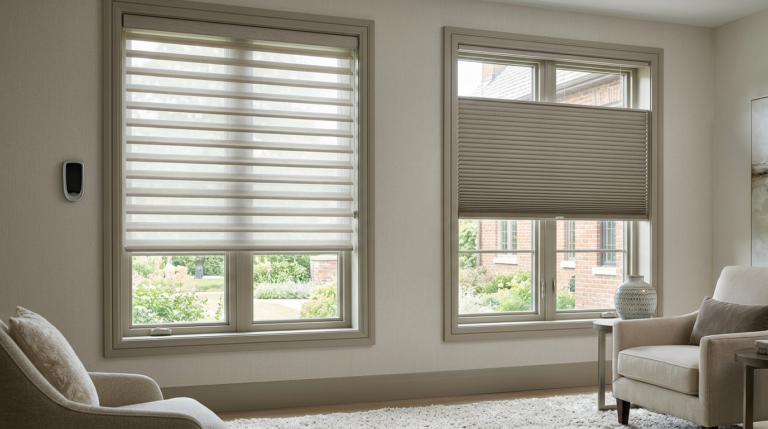
The core difference between room darkening vs blackout shades centers on fabric weave and total solar obstruction: room darkening materials diffuse intense sunlight to cast a deep, comfortable shadow across living spaces, while blackout designs utilize completely opaque textile backings to prevent virtually all light penetration. Custom Shades of London helps homeowners tailor this balance by outfitting premium roller shades with custom opacities to suit everything from daytime glare reduction to absolute bedroom privacy. For spaces like nurseries and home cinemas where complete darkness is essential, specialized side channels can also be integrated to eliminate any remaining perimeter haloing.
Overview
Evaluating window treatments requires balancing natural daylight with privacy and glare control. Selecting between room darkening vs blackout shades depends on how much illumination a space receives and whether total darkness is needed for sleep or media viewing.
The following sections break down technical fabric metrics, hardware options, and room-specific applications. This guide also includes a labeled real-world hypothetical featuring a custom installation to illustrate how these decisions work in practice.
- Light Blocking Ratios: compare measurable performance and light blocking capabilities across common shade opacities.
- Fabric Construction: examine specialized weave density and nighttime privacy levels across various material styles.
- Side Gap Solutions: discover how channel systems address side light gaps around window frames.
- Room Opacity Guidelines: determine appropriate material weights when selecting fabric opacity for distinct living spaces.
- Real-World Example: review a practical scenario featuring a homeowner window upgrade across multiple rooms.
- Treatment Comparison: review practical performance tradeoffs when comparing opacity styles side by side.
Standard window treatments often leave homeowners confused when distinguishing room darkening vs blackout shades. Hunter Douglas® defines these performance classes by how much direct illumination penetrates the textile weave. Room darkening textiles dim incoming daylight to eliminate harsh screen glare while sustaining a softened ambient glow, which suits home offices and main floor living areas. In contrast, blackout fabrics stop incoming light completely through the material surface to create dark interior environments for nurseries, home theatres, and bedrooms.
Light management also affects residential energy consumption throughout southwestern Ontario. Data from Health Canada shows that drawing window coverings during peak sunshine hours blocks solar heat gain, reducing cooling demands during humid summer afternoons. Matching the right textile opacity to the orientation of each window ensures proper privacy, precise glare control, and consistent daytime comfort.
Light Reduction Benchmarks for Room Darkening and Blackout Fabrics
Hunter Douglas product standards from November 2026 classify room darkening and blackout as distinct performance tiers on the light-control spectrum. The primary variance lies in how the textile manages incoming illumination at the window pane. Room darkening fabrics filter out up to 95% of daylight, softening harsh outdoor brightness while preserving a gentle ambient glow. In contrast, blackout fabrics integrate an opaque backing designed to block nearly 100% of light from penetrating the material.
Choosing between these two opacities depends largely on the functional demands of each living space. While room darkening materials diminish glare and soften harsh interior shadows, they do not produce complete darkness across the glass. For spaces requiring flexible illumination alongside screen comfort, homeowners often install Duette® Honeycomb Shades in room darkening opacities. Our installers frequently fit these honeycomb profiles to balance direct sun exposure across south-facing glass while preserving daytime usability.
Blackout textiles serve settings where any entering daylight compromises sleep or specialized visibility. Engineered with dense, light-impenetrable backing layers, these treatments target settings such as shift-worker sleeping quarters, children’s nurseries, and home theaters. To achieve balanced control across multipurpose rooms, many households pair opaque panels with Pirouette® sheer shades or dual-opacity systems that transition from softly diffused daylight to deep nighttime opacity.
| Shade Category | Rated Light Blockage | Fabric Construction | Recommended Room Placement |
|---|---|---|---|
| Room Darkening | Filters up to 95% | Semi-opaque woven or cellular textile | Home offices, living rooms, guest bedrooms |
| Blackout | Blocks nearly 100% | Textile bonded to an opaque liner | Nurseries, shift-worker bedrooms, media rooms |
Managing window frame perimeters is just as important as fabric opacity. Standard inside-mount installations leave narrow light gaps along the glass perimeter where mounting hardware requires operating clearance. For homeowners in London, Ontario seeking maximum darkness against low-angle morning sun or nighttime street lighting, selecting an opaque liner provides the fabric barrier, while specialized channel hardware helps manage edge light bleed.
Light Blocking Ratings and Core Fabric Design Differences
Hunter Douglas classifies room darkening and blackout as distinct performance grades based on measurable textile construction rather than interchangeable marketing terms. According to manufacturer standards recorded in November 2026, room darkening fabrics filter out up to 95% of incoming daylight. In contrast, true blackout treatments block nearly 100% of light by incorporating a specialized, fully opaque backing or inner core that prevents illumination from penetrating the weave.
Room darkening textiles soften harsh direct sunlight, minimize monitor reflections, and eliminate interior silhouettes while still allowing a gentle ambient glow across the room. Health Canada notes that drawing window treatments during peak afternoon hours reduces residential solar heat gain. We often install Duette® Honeycomb Shades in southern exposures where homeowners want to diffuse blinding midday rays without plunging functional living areas into total darkness.
Blackout textiles serve spaces where darkness directly dictates sleep quality or entertainment visuals. By stopping light transfer entirely across the pane surface, these dense materials create pitch-black conditions across several key living zones:
- Shift-worker suites and infant nurseries requiring midday darkness for consistent sleep routines
- Dedicated media rooms needing total reflection control on projection screens and high-definition monitors
- Upper-floor primary bedrooms exposed to municipal streetlights or early summer sun
Precision measurement determines actual performance in every installation. While an opaque fabric stops incoming rays through the shade itself, peripheral edge gaps can still admit halo light. For homeowners seeking maximum light control, Hunter Douglas offers LightLock® side channels that integrate along the window casing to virtually eliminate light gaps around the borders of the textile.
Defining Room Darkening and Blackout Light Control Standards
Selecting window coverings requires distinguishing between fabric opacities that diffuse daylight and opaque assemblies engineered to stop incoming rays. Manufacturer specifications from Hunter Douglas establish that room darkening textiles filter out up to 95% of incoming daylight as of November 2026. Rather than creating a pitch-black interior, these materials soften direct glare and eliminate harsh interior shadows while allowing a subdued ambient glow to remain in the space.
Duette® Honeycomb Shades provide an effective example of room darkening engineering, pairing honeycomb air pockets with cellular fabrics that temper severe southern or western sun. For common living zones like a shared family space or a dual-purpose workspace, these treatments maintain visual comfort without making the interior feel closed off from the outside world. Health Canada observes that lowering shades or drapes during peak sun hours curbs interior solar heat gain, adding thermal utility to everyday glare reduction.
Roller shades and other custom styles can also be specified with dedicated blackout fabrics, which incorporate an opaque liner designed to block out nearly 100% of light through the textile. This absolute barrier prevents surface light transmission across the window pane, making it the highest opacity grade available for residential glass. We routinely install these opaque treatments in primary suites, shift-worker bedrooms, infant nurseries, and home theater settings where exterior streetlights or midday sun would otherwise disrupt sleep or wash out screens.
| Feature | Room Darkening Treatments | True Blackout Assemblies |
|---|---|---|
| Light Blockage Rating | Filters up to 95% of daylight (Hunter Douglas, Nov 2026) | Blocks nearly 100% of light through fabric (Hunter Douglas, Nov 2026) |
| Fabric Construction | Dense woven or cellular textiles without full opaque backing | Integrated opaque liner sealing the textile body |
| Interior Illumination | Muted glow with reduced glare and subdued shadows | Near-complete darkness across the fabric face |
| Primary Room Applications | Home workspaces, guest rooms, and bright living areas | Nurseries, shift-worker suites, and dedicated media rooms |
LightLock® side channels illustrate how hardware addresses perimeter haloing, wrapping around the shade margins to virtually eliminate light gaps rather than claiming to remove edge light entirely. When managing window light in London homes, pairing the correct opacity level with precise bracket placement ensures each room receives the targeted degree of darkness it requires.
Room by Room Opacity Selection for Homes
Hunter Douglas classifies room darkening and blackout as distinct performance grades rather than interchangeable descriptions. Room darkening textiles filter out up to 95% of incoming daylight as of November 2026 manufacturer data, reducing harsh reflections and softening shadows while preserving a subtle ambient glow. True blackout treatments incorporate an opaque liner designed to block nearly 100% of direct illumination across the surface of the pane, creating near-total darkness rather than muted daylight.
Duette® Honeycomb Shades provide an effective balance when configured with room darkening fabrics, tempering intense western exposures while keeping interiors from feeling cavernous. Health Canada confirms that drawing window treatments during peak sun hours curbs daytime solar heat gain. We often install room darkening materials in areas where balanced illumination supports everyday activities:
- Living areas: Large window banks stay shielded from midday glare without sacrificing daytime brightness.
- Workspaces: An active home office setup benefits from reduced computer display washouts while retaining natural illumination.
- Secondary bedrooms: Guest rooms provide comfortable morning light transitions for visitors who dislike waking up in pitch-black surroundings.
Opaque textiles serve functional requirements when darkness dictates restful sleep or recreation. We mount blackout fabrics in primary suites facing streetlights, children’s nurseries requiring consistent midday sleep environments, shift-worker quarters, and home theaters needing crisp projection surfaces. Selecting custom Roller Shades fitted with opaque backing ensures light stops directly at the window pane, providing reliable performance through long summer days.
Defining Room Darkening and Blackout Performance Standards
Manufacturer specifications from Hunter Douglas differentiate room darkening and blackout products into two distinct performance tiers based on verified opacity measurements. As of November 2026, Hunter Douglas states that room darkening shades filter out up to 95% of outside light, tempering intense glare and heavy shadows while still permitting a gentle ambient glow to pass into the living space. In contrast, blackout fabrics integrate a specialized opaque liner engineered to block nearly 100% of light directly through the textile, preventing incoming rays across the window surface.
Duette® Honeycomb Shades provide an ideal example of how room darkening fabrics function across high-exposure zones. We fit these pleated cellular treatments in multi-purpose family spaces, guest suites, and southwest-facing rooms where residents want to cut harsh screen reflection without turning the room pitch black. According to Health Canada, drawing window coverings during peak sunshine hours cuts down solar heat gain, which improves indoor thermal comfort during hot summer afternoons.
Custom window coverings built with dedicated blackout textiles serve rooms where outside light disrupts sleep or daytime utility. We recommend true blackout liners across spaces with strict lighting demands:
- Infant and toddler nurseries where restful daytime naps depend on eliminating midday sun
- Primary bedrooms exposed to overhead municipal streetlamps or direct eastern sunrise
- Shift-worker sleeping quarters that require consistent darkness during normal daylight hours
- Dedicated home theaters where stray reflections wash out projection systems and television screens
Hunter Douglas shades configured with blackout materials control the direct transmission of daylight through the fabric itself, but edge light gaps remain an architectural reality on inside-mounted treatments. While blackout textiles block nearly 100% of light through the weave, ambient daylight can still wash around the narrow tolerances between the fabric edge and the window jamb, making precise mounting and proper system selection essential for true darkness.
Defining Opacity Levels Across Window Treatments
Manufacturer standards from Hunter Douglas, documented as of November 2026, classify window shading into distinct operational tiers rather than treating room darkening and blackout as interchangeable labels. Room darkening fabrics filter out up to 95% of incoming daylight, cutting glare and sharp shadows while still letting a soft, diffused ambient illumination permeate the room. In contrast, blackout fabrics integrate an opaque liner engineered to block nearly 100% of light directly passing through the textile, producing the deepest level of shade attainable on a window pane.
How Room Darkening Fabrics Manage Sunlight
Engineered room darkening textiles temper intense sun exposure without plunging an interior into pitch-black conditions. When fitting south-facing or west-facing spaces, Duette® Honeycomb Shades provide cellular pleats that mute exterior glare while maintaining a comfortable daytime atmosphere. Health Canada notes that drawing window coverings during peak solar hours helps decrease indoor heat gain, delivering practical thermal moderation alongside balanced light reduction.
We regularly specify room darkening opacities for distinct residential living zones:
- Bedrooms where occupants prefer waking with gradual morning daylight rather than complete morning darkness
- A dedicated home office workstation requiring sharp reflection control on monitors without eliminating ambient desk light
- A shared family living room with broad glass exposures that collect harsh midday sun
- Multipurpose guest suites that benefit from versatile daylight moderation throughout the day
Blackout Fabrics and Opaque Liners
Achieving near-total dark conditions requires blackout fabrics built with specialized backing materials. Because the textile incorporates an impermeable barrier, incoming sunlight cannot penetrate the weave of the fabric panel. Custom Shades of London installs these opaque window coverings for spaces where dependable dark environments remain necessary for daytime sleep or glare-free display screens:
- Primary bedroom suites impacted by bright streetlamps or early sunrise hours during long Ontario summers
- Children’s nurseries that require dark environments for midday infant nap routines
- Dedicated entertainment and media rooms where ambient reflections wash out projection or television screens
- Shift-worker bedrooms that require dependable midday darkness for restorative rest
While the blackout textile stops nearly all light from passing through the fabric, window frame clearances can still permit light bleeding around the edges. Precision mounting measurements help minimize perimeter gaps, ensuring the selected opacity delivers its intended performance in your home.
FAQ
Explore the guide below for clear answers to the most common questions regarding room darkening vs blackout shades. Whether you are outfitting a nursery or a media room, these quick insights will help you select the ideal light control for your home.
| Question | Answer |
|---|---|
| Should nurseries use room darkening or blackout shades for daytime naps? | Blackout shades provide the deepest darkness for daytime sleep routines, blocking up to 99% of incoming sunlight through opaque weaves or specialized liners. Room darkening fabrics still filter roughly 95% of daylight, which leaves a soft ambient outline around furniture that can keep sensitive infants awake. If your nursery faces direct afternoon sun in London, Ontario, blackout fabrics provide the most dependable sleep setting. |
| How do you prevent side light leakage around blackout window coverings? | An inside mount naturally leaves narrow vertical gaps alongside the casing so the fabric rolls without rubbing the jamb. Pairing your shade with side light-blocking channels, such as the Hunter Douglas LightLock™ system, seals those perimeter edges. Homeowners in London, Ontario can also specify an outside mount that overlaps the trim by several inches or layer side drapery panels over the casing. |
| Can you see through room darkening shades from the outside at night? | Room darkening fabrics provide complete nighttime privacy, preventing passersby from seeing indoor shapes or silhouettes even with interior lights switched on. Unlike sheer or solar screens that turn transparent after dark, these denser weaves stop direct sightlines entirely. They deliver full evening privacy in bedrooms and street-level living spaces throughout London, Ontario. |
| Why do media rooms perform better with blackout materials rather than room darkening textiles? | Modern television displays and projection screens reflect ambient light, washing out deep black levels and fine contrast. Room darkening textiles permit up to 5% light transmission, which creates enough residual room glare to diminish picture quality during bright midday hours. If you want a true cinema experience in your London, Ontario home, opaque blackout fabrics remove ambient wash completely. |